by Carole Epp | Apr 12, 2013 | Uncategorized
If you’re like me and would love to have more time to read up on the world of ceramics but filtering through all of the posts, events, musings, etc every month is too time consuming – then check out Pottery Making Blog as once a month they do a Clay Blog Review and post a wrap up of some of the wonderful things over the last month you should make sure not to miss.
So handy and helpful!
: )
www.potterymakinginfo.com
by Carole Epp | Apr 10, 2013 | Uncategorized
“Objective Clay was founded by fourteen artists with a
shared vision to create an artist established and maintained online
space. This space functions as a gallery to view our latest work as
well as a window into our current thoughts in process. By sharing our
ideas and opening our studios, we invite artists, non-artists,
educators, and students to actively engage in our artistic practices. In
this virtual studio, the people who love pots can view/purchase new
work and form direct relationships with the artists who make them.”
emily schroeder willis, gwendolyn yoppolo, jennifer allen, nicholas bivins, blair clemo, sunshine cobb, brian hopkins, brian r. jones, lindsay oesterritter, kip o’krongly, doug peltzman, monica ripley, deborah schwartzkopf, shawn spangler
objectiveclay.com
www.facebook.com/objectiveclay
by Carole Epp | Apr 9, 2013 | Uncategorized
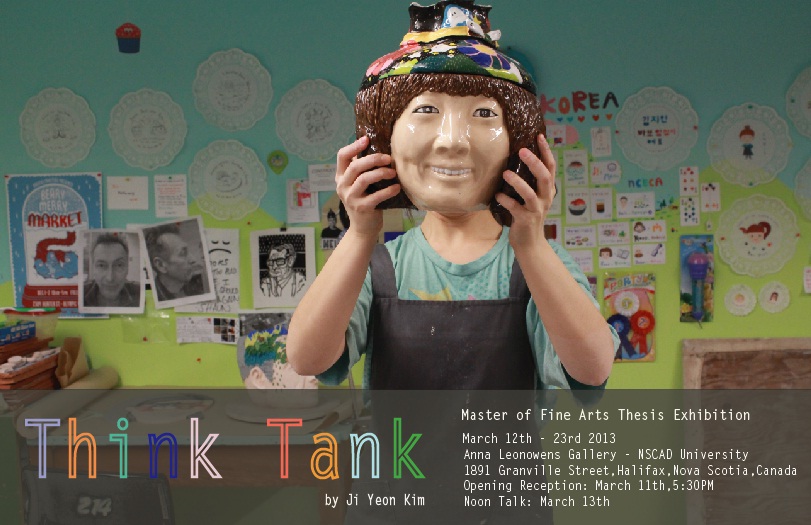
A huge thanks to today’s guest writer, the amazingly talented Bridget Fairbank of B Practical Pottery Blog. I’m sure you all are followers of her blog, but if not, make sure to start! When I saw some of the images from Ji Yeon’s Think Tank exhibition on Bridget’s instagram feed I started begging for more pictures and bugging Bridget for a review. Looks like it was an amazing show and I’m thrilled to read Bridget’s review below.

Review: Ji Yeon’s Think Tank
The subject of this review is Think Tank: A Master of Fine Arts Thesis Exhibition by Ji
Yeon Kim shown at the Anna Leonowen’s Gallery in Halifax N.S. March 12-23 2013 comprising
of delightful ceramic sculptures and functional work dealing with the complexities of being a
South Korean in Canada. Themes of culture shock, fear and adaption run through each work in
the Think Tank, however the show is anything but dark, rather the work is Ji’s joyful
manifestation of overcoming difference with a childlike resilience embodied in wonderment and
playfulness.
 The exhibition is named Think Tank in honor of Ji’s professors Neil Forrest and Rory McDonald. Jars rendered as portraits of all three are the feature of the exhibition (see photo to the left and below) and act as repositories for spectators comments written on doilies. With this action the think tank is ever being replenished and expanded. It is a great example of the interaction and playfulness Ji promotes. The original triad has been pivotal to Ji’s progression and studies at NSCAD University. Coming highly technically skilled from previous training in South Korea and used to working in a constrained environment Ji’ explains, “their personalities are really open and they are whimsical, funny individuals” (interview) their interactions allowed her to experiment and play in all aspecting of thinking and making. A sense of coy play permeates all aspects of Ji’s practice. Ji’s studio at NSCAD, a secretive place you must have the a password to get into (for your information the password is “little monster”, shhh!) “is the gateway to [her] artistic practice; the most important ideas in [her] practice are play, color, culture, language and interaction with people. [Her] work is about more than simple playfulness. It is a ceramic
investigation into a cultural adventure” (thesis). With this playful and
respectful tone Ji asks us all to take a look at her work and join in
her story, a story such that every traveller knows.


Walking into the exhibition we are faced with a wall painted in undulating light blue and lime green lines of color and adorned with more doilies, Ji’s preferred paper to sketch on. These
bright colors and sketches are translated straight from Ji’s studio space, it is her way of reaching
out to the viewer and an extension of Ji herself, always the bright and cheery artist. The colors
mask the white walls of the gallery not only to comfort us but also Ji. Ji is afraid of the color
white, for in South Korea white is the color of mourning and so tells the story of death.
This fear is actually what led Ji to clay because clay is a warm hue unlike a stark white primed canvas, Ji relaxes when working with the medium. More themes of cultural difference arise as in her artist talk Ji explains how shocking it was to see how Haligonians have old cemeteries in the middle of the city and real estate around them is costly- in Korea ghosts would not be welcoming neighbors. Thus Ji surmises that Canadian ghosts are friendly and ghosts become her mascot in Canada. The three jars we encounter next and sure enough Ji’s self portrait depicts Ji wearing a hat with ghosts on it happily flying around in the night. In her eyes we see drawn a question mark and exclamation mark depicting what every piece in the show communicates. Likewise in McDonald’s portrait shows him dawning his toque, which he always wears, where Ji surmises he keeps all his power and energy and secrets. Forrest’s portrait bares no wrinkles or sign of aging with electric green hair he embodies his youthful demeanor, he has no hat symbolizing his
sharing and blunt nature.
Ji says that her work here is more childish compared to what she would have made in
Korea, her initial language barrier rendered her verbal communication childish and so she began
to artistically communicate using childlike sentimentality. In this way we are reminded that
words aren’t even necessary, exchanges can happen in different ways on many levels. The
participation aspect is new to Ji’s work and came from a happy mistake, a letting go of sorts. The
piece Jay Rider, 2011 is a ceramic rendition of a rocking horse but instead of a horse it is Ji’s dear
friend Jay one is asked to mount.
 Ji had made a similar piece depicting her father in Korea. When she created Jay in Canada the piece developed a hairline crack on the belly, Ji changed her mind and thought, “maybe everyone can ride his back” (interview). Even knowing the crack was there I paradoxically really wanted to participate, even knowing I could literally be the straw that broke the horses back. This exemplifies just how strong Ji’s work draws the viewer in to engage and enjoy.
 The crack was liberating and freed Ji to make art objects that physically engage the audience such as Whimsy Whimji Bridge, 2013 a play on the song “The London Bridge is Falling Down” a life size sculpture with hands raised to the sky asking you to join in the game.
 Further more participants are invited to decorate the white apron worn by the figure, an effort to cover up white voids with meaningful bright human interaction. Ji says, “spaces of play are where children (and adults) get to explore, discover, create and imagine” and so with her work she creates that space for us.
In the center of the Anna LeonOwens is the three Think Tank jars, Whimsy Whimji Bridge and Jay Rider occupy the middle of the gallery floor and on the walls are tiles and plates. A series entitled Homesick Sometimes, 2013 consists of three self portrait wall tiles narrating Ji’s personal triggers- the cold winter, missing her dogs and culture shock. The pieces are dark yet delightful. Ji uses imagination for comfort and communication. Ji says “life is unpredictable, busy, complicated, and dramatic. It has ups and downs; it can be joyful exultant moments or heartbreaking disappointments… [she] likes to indulge [her]self with daydreams. Sometimes they take [her] away from reality” (thesis) this is something we all feel and need.
 Further along the gallery wall we encounter Aww Oh! Sign, 2013 a wall piece that protrudes out into the room like a shop sign and depicts a shocked Ji, mouth agape. Ji says many things are shocking about Canadian Culture like marijuana and overt sexuality sometimes her only response is “Aww Oh!” and we’ve all had that reaction before!
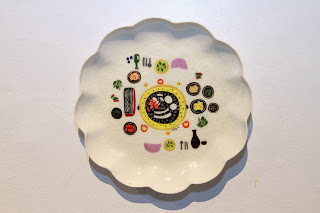 Next two sets of plates entitled Two Missing Plates, 2012 tell of Ji’s forays into Halifax trying to find ingredients to make Korean food and having no such luck. My personal favorite is Meal with a bowl of rice, soup, and side dishes. At last we see the piece I don’t want to wake up at 9AM because Canada’s winter is too cold, 2012 a set of three plates decorated with sleepy bears unwilling to emerge from the warm covers of their beds. Once again a feeling every Canadian knows well.
Ji’s work is largely autobiographical but anyone who has ever been a foreigner somewhere or spent some time in Canada can relate to the themes put forth by Think Tank and Ji’s personal experience. The exhibition is a profoundly personal one and acts as a reminder to view the world in wonder and stay open minded.
Please take a moment to explore Ji’s past body of work at http://www.hi5jiyeon.com
by Carole Epp | Apr 9, 2013 | Uncategorized
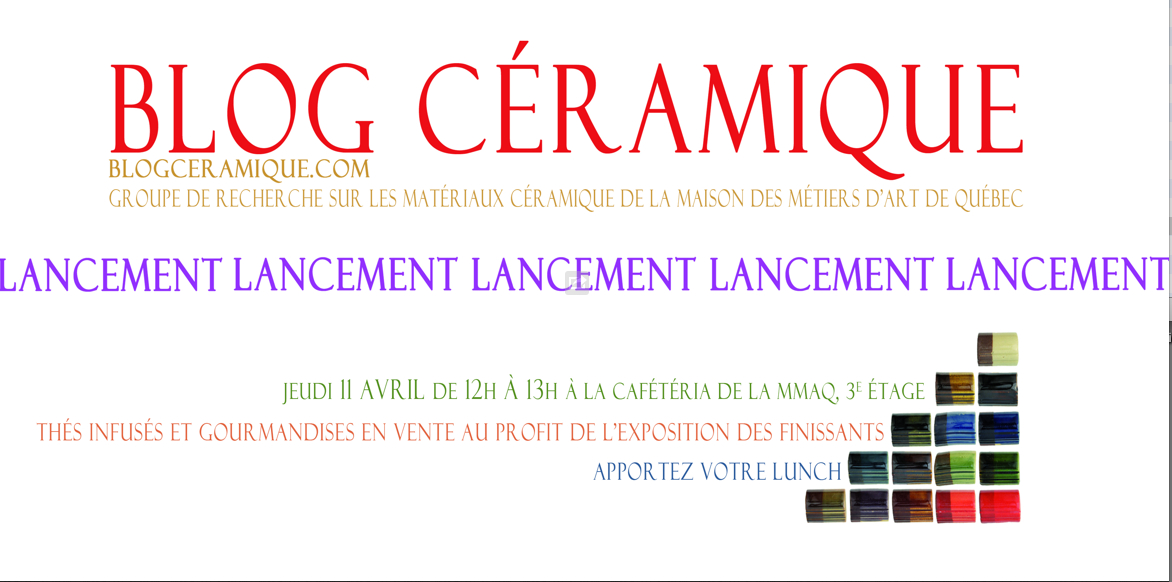
Vous êtes cordialement invités au lancement de
blogceramique.com, un espace de partage d’expertise du Groupe de recherche sur les matériaux céramique de la Maison des métiers d’art de Québec.
Le lancement aura lieu le jeudi 11 avril
2013, de 12 h à 13 g à la cafétéria de la MMAQ, 3e étage. Thés infusés
et gourmandises seront vendues au profit de l’exposition des finissants
de la cohorte 2013. Apportez votre dîner et bienvenue à tous.
You are cordially invited to the launch of blogceramique.com a space for sharing expertise of the Research Group on ceramic materials of the House of Crafts Quebec.
The launch will take place Thursday, April 11, 2013, from 12 am to 13 g in the cafeteria MMAQ, 3rd floor. Brewed teas and sweets will be sold for the benefit of the exposure of the cohort graduating in 2013. Bring your lunch and welcome.