by Carole Epp | Feb 10, 2011 | Uncategorized

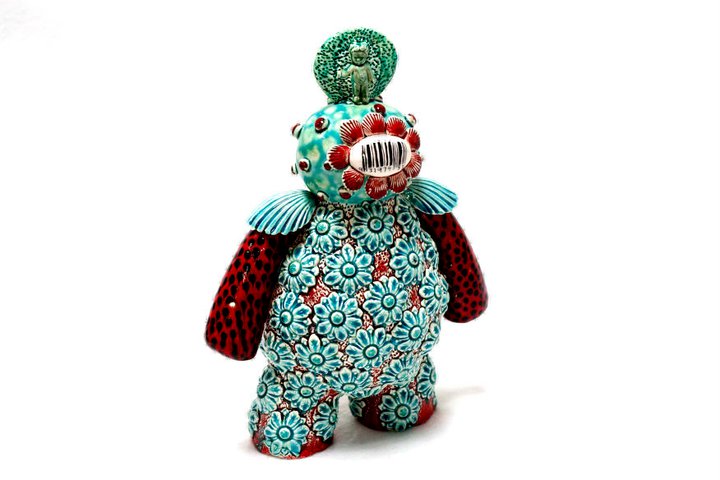
I graduated from College in 2009, spent 3 months travelling in the UK, Ireland, France and Europe last year with my husband and came back fully energised. I won an Award for my mini installation of Porcelain Paperclay at the Port Hacking Potters Group Competition last October. I have tried painting and silver work but just love the feel of getting my hands on clay.

There are so many possibilities I find it hard to concentrate on one type of clay work. I love throwing on the wheel but also enjoy handbuilding or combining the two. My love of flowers shows in my decoration and living in a multi-cultural city, I also find a Asian influence coming through in my style. I use either stoneware or porcelain clays and fire in an electric kiln.
The above photos are of work in my graduation show and also one of my little pigs – my fun side.
My blogs are: http://annasceramicportfolio.blogspot.com and http://annasceramics.blogspot.com
by Carole Epp | Feb 8, 2011 | Uncategorized
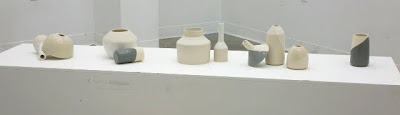 Kelly is a fourth year student in Vancouver at the Emily Carr University focusing in ceramics.
Here’s a bit about her work:
I strive to maintain balance between design, craft and art when creating. Working by hand, on the wheel and with molds, is a political choice I make which values strong craftsmanship in our modern world. I am drawn to the domestic interior space and create objects for use in daily life which connect with people over a long period of time.
Drawn to minimal form and subtle surface, I am interested in the way light, shadow, line and proportion interact. I am passionate about making contemporary work that relates to our culture today and it is my hope to continue building my knowledge of the ceramic medium through education, personal work and teaching.

by Carole Epp | Feb 8, 2011 | call for entry, emerging artist, job posting, monday morning eye candy, movie day, residency opportunity, show us your influences, technical tuesday
Carbondale Clay Centre will be looking for a new Ceramic Studio Tech Residency for June 2011-June 2012. Deadline for applications and supporting material is April 4th and notification is April 20th. Click here to download information. We are also looking for Ceramic Resident Artists for our Twelve Month Residency Program. Application deadline is April 4th and notification is April 30th. Click here for information. Please email us at [email protected] for any other questions. Please look for us at NCECA to interview for the positions!!
by Carole Epp | Feb 3, 2011 | Uncategorized

Recently the amazing sweet and generous (and equally talented) Vipoo Srivilasa contacted me about an auction he was putting together for the QLD government flood relief. I was incredibly honored to be approached to participate as Australia will always be near and dear to my heart and many of my close friends live there, some in the affected areas of the flood.
Here’s a bit from his website: Prominent Melbourne ceramicist Vipoo Srivilasa was distressed by the unfolding tragedy, and has organised an auction featuring the donated works of well known and award-winning artists to raise funds for The Premier’s Disaster Relief Appeal (www.qld.gov.au/floods/donate.html).
Srivilasa’s call-out for his friends and colleagues to donate has exceeded his expectations, and he is currently fielding expressions of support from as far away as North America. “The response has been overwhelming! I was planning for maybe twenty artists to join me but I reached forty in no time. It’s turning into a much bigger project than I expected”, he admits.
The auction will happen online at ebay.com.au from Friday 4th to Sunday 6th February, 2011.
It is now live at http://shop.ebay.com.au/srivilasa/m.html
Each Item is listed to finish 2 minutes apart, with the first item to finish on Sunday 6 Feb at 8.00pm, and the last one to finish at 9.30pm.
The idea is if you miss the first piece, you can still bid on the second or third piece and so on. To be able to make a bid you need an eBay account (www.ebay.com.au ). You can register for free.
Please follow the link for more details: http://help.ebay.com.au/Help/Getting_Started/Manage_your_account/Registration
or go straight to registration page: https://scgi.ebay.com.au/ws/eBayISAPI.dll?RegisterEnterInfo&siteid=15&co_partnerid=2&usage=0&ru=default&rafId=0&encRafId=default
There are some pretty amazing artists donating work (42 pieces I believe), as well as little old me, so please go and check it out, bid on some amazing work, and please forward the links as far an wide as possible.
UPDATE:
Here’s the full list of artists:
Akio Takamori (USA)
Angela Valmanesh (SA)
Avital Sheffer (NSW)
Ayumi Horie (USA)
Bridget Bodenham (VIC)
Carole Epp (CAN)
Christopher Plumridge (VIC)
Cyrus Tang (VIC)
Dawn Whitehand (VIC)
Fleur Schell (WA)
Gerry Wedd (SA)
Greg Daly (NSW)
Heather Creet (TAS)
Irianna Kanellopoulou (VIC)
Jacqueline Clayton (NSW)
Jane Sawyer (VIC)
Janet DeBoos (ACT)
Janet Mansfield (NSW)
Julie Bartholomew (NSW)
Kenji Uranishi (QLD)
Kevin White (VIC)
Laura McKibbon (CAN)
Lene Kuhl Jakobsen (VIC)
Louise Boscacci (NSW)
Lynda Draper (NSW)
Marilu Guzman
Naoko Yehenara (NSW)
Paul Aburrow (VIC)
Paul Davis (VIC)
Penny Smith (TAS)
Sandra Black (WA)
Sandra Black (WA)
Shannon Garson (QLD)
Shin Koyama (QLD)
Simon Braund (VIC)
Somchai Charoen (NSW)
Sony Manning (VIC)
Sophie Milne (VIC)
Tanawat Suttasoontorn (VIC)
Tatiana Gvozdetskia (VIC)
Vicki Grima (NSW)
Vipoo Srivilasa (VIC)
Cheers!
by Carole Epp | Feb 2, 2011 | call for entry, emerging artist, job posting, monday morning eye candy, movie day, residency opportunity, show us your influences, technical tuesday
DEADLINE: MARCH 2, 2011
Exhibit Dates: April 15 to May 13, 2011
For millennia people have made things out of burnt earth. From bowls and jars essential for preserving foods to ensure survival, to written documents and official seals, to talismans of devotion for various deities and other ritualistic purposes. Ancient kilns were one of humanity’s earliest forms of factory-based mass-production. Today the role of fired earth persists in both old and new ways. FIRED is an invitation for artists to submit works that in some way represent the use of the medium of ceramics. There is no other thematic restriction, and our jury fully expects to consider a range of types of work, from the very traditional to highly unexpected ‘contemporary’ interpretations of the medium. Manifest’s goal is to assemble a diverse array of works of ceramics for an exhibit spanning our Drawing Room and Parallel Space galleries that will be unified by virtue of its exploration of the medium, but intriguing and insightful due to the wide variety of approaches taken by artists working in ceramics. Eligibility: FIRED is open to everyone. Professionals as well as students are encouraged to enter. The only limitation is that entries must represent original works of art and represent the incorporation of ceramics as an essential part of the work. Media: Open to all traditional and non-traditional genre and media, including mixed media, which incorporate ceramics in some significant way. Jury and Curator: Manifest’s selection process involves a complex two-part system. This exhibit will be juried by a 5-9 member panel of professional and academic advisors with a broad range of expertise. The jury will then pass along their recommendations to the exhibit curator who will make the final selections from the jury-approved pool. Catalog: Manifest will produce a full-color catalog documenting the work selected for exhibit. Each exhibiting artist will receive one free copy of the catalog. Manifest is unique among galleries and museums around the world for designing and producing a high-quality full-color book for every exhibit produced. By offering one complimentary copy of the catalog to exhibitors, Manifest continues to expand how it serves its non-profit mission and the artists who make it all possible. Artists will receive their copy either in person when picking up work after the exhbit, or with the return shipment of their artwork. Additional copies can be purchased via the online bookstore. For examples of past catalogs visit Manifest Press. Delivery and Return of Work: All work accepted for the exhibition must arrive ready to install. Works not gallery-ready, or not exhibiting good craftsmanship, may be omitted from the exhibit. Accepted work that differs significantly from the entry images or suffers from poor presentation, will be disqualified. Please note that professional-level presentation is a must. Work may be hand delivered or shipped. Shipped works must be sent in an easily reusable container/packaging with return shipping prepaid. Works will be returned in the same manner as delivered or via UPS/USPS. All work must arrive at Manifest by the specified date (see calendar below). Accepted work will remain on display for the duration of the exhibition. Works not claimed within 30 days of the end of the exhibit will become the property of Manifest. The artists are responsible for all shipping costs. Calendar:
| March 2 March 14 March 21 April 9 April 15 May 13 May 14-20 |
Deadline for receipt of entries Notifications sent by email Hi-res images needed for catalog and PR Artwork due to Manifest by this date Opening reception Final Day of Exhibition Pick-up/ship artwork |
Insurance: Works will be insured while on gallery premises. Insurance covers theft, vandalism, damage caused by gallery patrons or staff (in accordance with insurance policy). PLEASE NOTE: Insurance does not cover damage caused during shipping due to any reason, including mishandling by carrier or failure of packaging to protect works in transit. Also not covered is damage caused to work by failure of the work itself, its mounting systems installed by the artist, or disintegration/degradation due to the nature/quality of materials or craftsmanship. Entry Fee: Each work submitted must be accompanied by a $10 non-refundable entry fee. Number of entries is unlimited. Entry fee must be paid by U.S. check or U.S. or International money order made payable to MANIFEST, or by credit card via PayPal. (If paying by PayPal PLEASE use the paypal link provided on the page that follows the submission of the online entry form.) Detail images may be included at no additional cost, but should only be included if necessary for understanding the nature or quality of the artwork. How many works should I submit?
The average number of works submitted to typical Manifest calls is 3. Some artists like to submit several more, especially if they have a couple different bodies of work which they’d like our jury to consider, or if they have a suite of works that are interrelated. While we have absolutely no minimum number required (other than one), nor do we give an advantage to those who submit more, it is helpful to have a few options to select from. Our jury often gains insight into one work by seeing it in context with a few others by the same artist. And we do routinely accept pairs or sets of work by artists once they are determined to be a finalist. Sale of Work: All work, unless indicated as not for sale (NFS), will be available for sale during exhibit. Manifest Gallery will retain a commission of 30% on all artwork sold during the exhibition. Images: In an effort to conserve resources Manifest accepts only digital images/files for consideration. See specifications below. The Gallery will retain the submitted images of accepted artwork and reserves the right to use the images in publications and gallery publicity. CD’s of works not selected will only be returned if accompanied by a SASE. SUBMISSION DETAILS / TO ENTER >>
via artrubicon