emerging artist: Jennifer Hansen Gard

My interest lies in medicinal herbs and plants that directly
affect the body. I am interested in using the ceramic vessel the explore
ethnobotony, which is defined as the study of “the relationship between people
and plants including various aspects of how plants are used for food . . . and
medicine” (Rai, Acharya, & Rios, 2011). As an artist I am questioning what
is the role of the plant in today’s society? What connects plants and people? I
am working to explore the relationship between plants and people through the
ceramic vessel.
affect the body. I am interested in using the ceramic vessel the explore
ethnobotony, which is defined as the study of “the relationship between people
and plants including various aspects of how plants are used for food . . . and
medicine” (Rai, Acharya, & Rios, 2011). As an artist I am questioning what
is the role of the plant in today’s society? What connects plants and people? I
am working to explore the relationship between plants and people through the
ceramic vessel.


I have set out to better understand specific plants through
researching the growing, harvest, and consumption. I supplement my ceramics
studio practice with a growing practice that includes an Herb Garden and greenhouse growing. I considered specific plant
needs for example companion planting and root structure in designing and
building growing containers. I used my hands to transform the clay through pushing,
pinching, and pulling creating vessels of containment.
researching the growing, harvest, and consumption. I supplement my ceramics
studio practice with a growing practice that includes an Herb Garden and greenhouse growing. I considered specific plant
needs for example companion planting and root structure in designing and
building growing containers. I used my hands to transform the clay through pushing,
pinching, and pulling creating vessels of containment.
At the same time I am growing, harvesting, and creating vessels
specific for the herbs I am also integrating vessels into my daily life. I
recently created a dish set that I used for every meal for a 30 days period. I
was thinking about the throw away culture we live in and how disconnected it is
from the growing practice that I am so deeply involved in. I question shouldn’t
what we eat and drink from have more value than trash? I performed the 30 Days
Project Part II later called The Dish Set
Challenge I through the month of November with a dish set that includes a
cup, bowl, and plate. I used it for every meal recording through photos and
updates on my blog. In December, I create The
Dish Set Challenge II with my husband Forrest where we used a connected dish
set plate, bowl and cup for every meal for one week. You can view both projects
at gardclaystudios.blogspot.com
specific for the herbs I am also integrating vessels into my daily life. I
recently created a dish set that I used for every meal for a 30 days period. I
was thinking about the throw away culture we live in and how disconnected it is
from the growing practice that I am so deeply involved in. I question shouldn’t
what we eat and drink from have more value than trash? I performed the 30 Days
Project Part II later called The Dish Set
Challenge I through the month of November with a dish set that includes a
cup, bowl, and plate. I used it for every meal recording through photos and
updates on my blog. In December, I create The
Dish Set Challenge II with my husband Forrest where we used a connected dish
set plate, bowl and cup for every meal for one week. You can view both projects
at gardclaystudios.blogspot.com


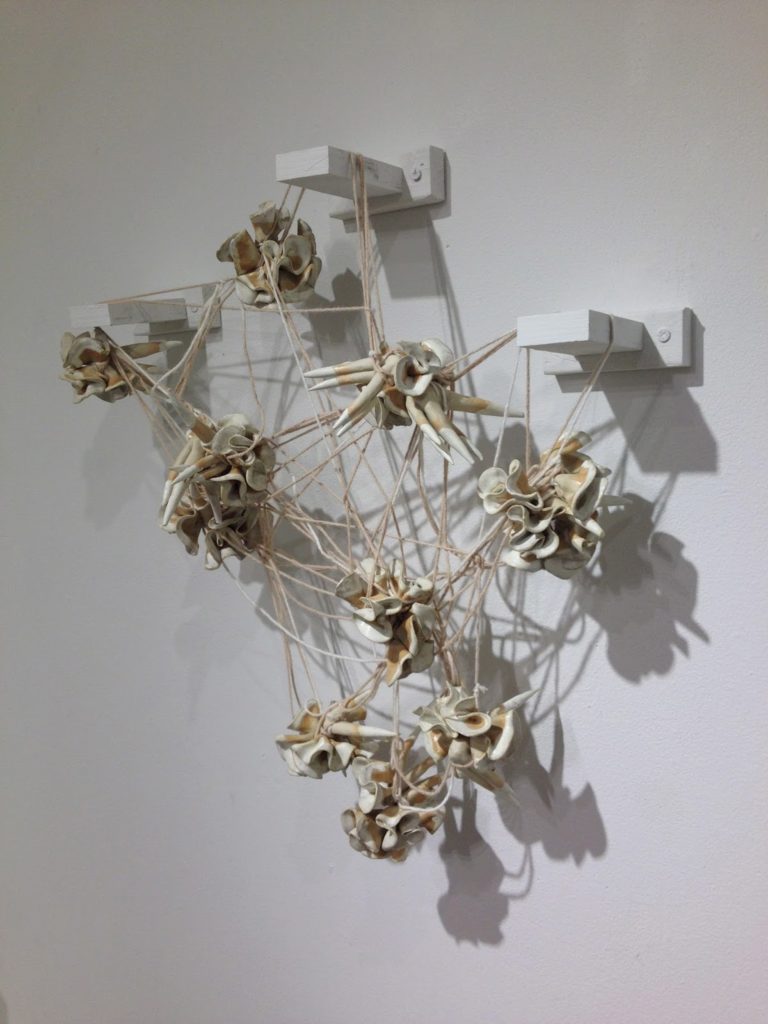
The work displayed in Coeval
as a product of my growing practice and includes turmeric, cayenne, and
moonseeds held in balance with a social practice. The Dish Set Challenge III will take place during the duration of
the exhibition from January 10th through February 7th,
2014. The project involves the help of five participants Belenda
Flucker, Aurelio Diaz, Keith Karchella. Violeta Chinni, and Jenny Lucas
Kaufman. These five participants and myself will be competing a 28 day Dish Set Challenge. The participants
will be presented with a handmade dish set made specifically for them. They
will eat and drink from it every day during the course of the exhibition. Each
day the participants will post on a group blog recording meals and reflecting
as they experience the project. The project
will commence at the opening reception with a meal that I prepare from 100%
local food I have collected from farms surrounding Mansfield. You can view the
projects daily progress at
as a product of my growing practice and includes turmeric, cayenne, and
moonseeds held in balance with a social practice. The Dish Set Challenge III will take place during the duration of
the exhibition from January 10th through February 7th,
2014. The project involves the help of five participants Belenda
Flucker, Aurelio Diaz, Keith Karchella. Violeta Chinni, and Jenny Lucas
Kaufman. These five participants and myself will be competing a 28 day Dish Set Challenge. The participants
will be presented with a handmade dish set made specifically for them. They
will eat and drink from it every day during the course of the exhibition. Each
day the participants will post on a group blog recording meals and reflecting
as they experience the project. The project
will commence at the opening reception with a meal that I prepare from 100%
local food I have collected from farms surrounding Mansfield. You can view the
projects daily progress at